🧠 The Mind Behind the Machine: Exploring the Creative Heart of Generative AI

Welcome to AravindInsights! I'm Aravind Kumar Yedida, a recently graduated Master's in Computer Science and an aspiring data analyst. Here, I dive into the exciting world of data analytics, business intelligence, and cutting-edge AI, always with a strong focus on responsible AI and digital privacy. Expect actionable insights, deep dives into ethical tech, and explorations of how technology can genuinely improve lives."
Part 1: The Synthetic Imagination
The question is not whether machines can think, but whether we can understand the thinking they simulate.
— Inspired by Alan Turing
🔍 Introduction: Beyond Imitation
For most of its history, Artificial Intelligence (AI) has been treated like an overachieving calculator—brilliant at logic, but not much else. It could play chess, crunch numbers, and obey instructions. But could it dream? Could it imagine?
Welcome to the new world of Generative AI—a domain where machines compose poetry, paint surreal landscapes, write software, and even mimic human conversation with eerie fluidity. This isn't just a matter of prediction or pattern recognition. It's about machines creating something new—not memorized, not copied, but synthesized.
The rise of Generative AI signals a paradigm shift: from artificial intelligence to artificial imagination.
📚 A Quick History of Machine Creativity
Before diving into how Generative AI works, let’s zoom out. The idea that machines could be creative isn’t new—it’s been brewing for decades:
In the 1950s, Noam Chomsky proposed the idea of generative grammar—that human language is not just remembered phrases, but a deep system for generating infinite, novel expressions.
In 1975, Marvin Minsky wrote about the “society of mind,” where intelligence arises from interacting simple parts—similar to today’s multi-modal models.
Ada Lovelace, often considered the world’s first programmer, envisioned that machines could one day compose music.
We’re now living in the realization of those dreams.
🧬 Computational Creativity: A Machine’s Drive to Invent
Unlike traditional rule-based systems, Generative AI does not operate with hard-coded logic. Instead, it learns to explore possibility spaces—vast mathematical terrains where every coordinate represents a potential word, image, or idea.
This is the domain of computational creativity.
Instead of asking, “What is the right answer?” Generative AI asks, “What is possible here?”
At the core of this lies probabilistic reasoning. That’s where the stochastic nature of these models comes in.
🌌 What Is Latent Space, Really?
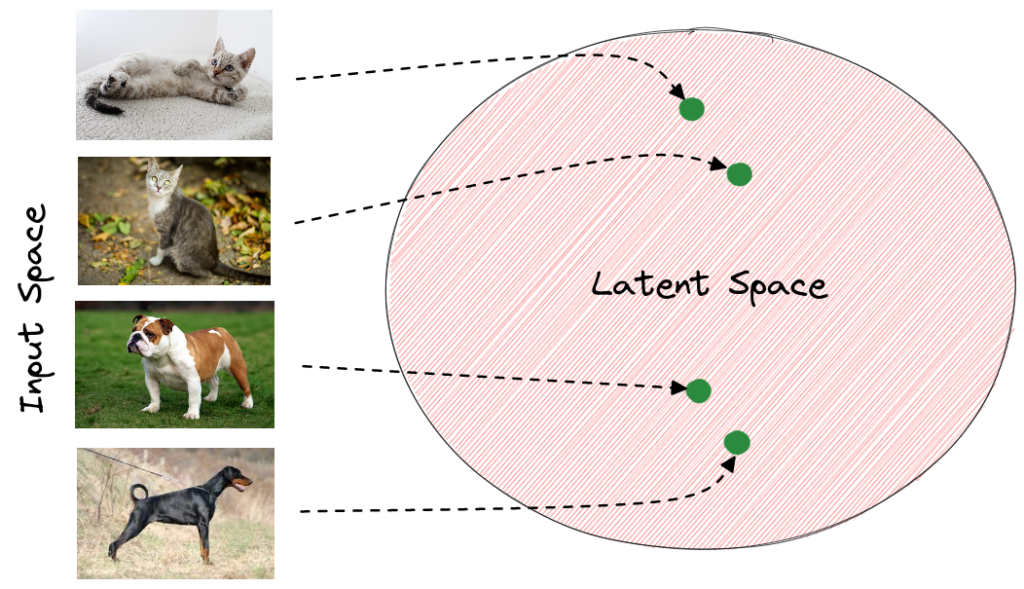
Generative models like GPT-4 or Stable Diffusion rely on something called latent space—a compressed, abstract representation of all the patterns the AI has learned.
Imagine this space as a cloud of imagination. Each point in the cloud isn’t a single word or picture—but a bundle of meaning, style, and structure.
Just as a painter recalls brush strokes from memory, a generative model navigates latent space to create something new.
The shapes within this space are described as neural manifolds—complex, curved paths that represent relationships between ideas. It's the digital equivalent of intuition.
⚙️ Stochastic Magic: Why AI Never Says the Same Thing Twice
Generative AI works by sampling—it doesn’t always choose the most likely output. It introduces randomness, guided by probability.
This is called stochastic modeling.
Here’s why it matters:
It allows for creativity. If models always picked the most likely word, they’d be boring.
It simulates the unpredictability of human thought.
It creates emergent semantics—meanings that arise naturally, rather than being preprogrammed.
🤖 Symbolic vs. Sub-symbolic AI: Two Approaches to Thought
Earlier AI systems were symbolic—they relied on formal rules. Think logic puzzles and if-then statements.
Generative AI is sub-symbolic. It doesn’t follow rules—it absorbs patterns. It learns the “vibe” of things, much like a toddler picking up language by listening, not by reading grammar books.
This shift from logic-based to pattern-based learning is why Generative AI feels so intuitive and humanlike.
🧠 Can Machines Really “Imagine”?
We tend to equate imagination with feelings, memory, and purpose. Machines don’t have any of these—at least not yet.
But what they do have is:
Multimodal learning: Text, images, audio—all processed and connected.
Reinforcement feedback: Human preferences used to guide output.
Generative adversarial cognition: A kind of internal dialogue, where one model creates and another critiques.
These architectures echo cognitive architectures from early AI research. They don’t simulate emotion—but they simulate intuition frighteningly well.
🧪 Sample Code: Text Generation with GPT-2
Here’s how you can run a simple text generation model locally using Hugging Face Transformers:
from transformers import GPT2LMHeadModel, GPT2Tokenizer

model = GPT2LMHeadModel.from_pretrained("gpt2")
tokenizer = GPT2Tokenizer.from_pretrained("gpt2")

prompt = "The future of creativity belongs to"
input_ids = tokenizer.encode(prompt, return_tensors="pt")

output = model.generate(input_ids, max_length=50, do_sample=True, temperature=0.9)
print(tokenizer.decode(output[0]))
Try modifying the prompt to explore how stochastic modeling affects the result!
🧭 Generative AI in Everyday Life
You may already use Generative AI without realizing it:
🧠 Auto-generated captions and summaries
📧 Email autocomplete (e.g., Gmail)
🎨 AI-generated social media ads
📝 Copywriting tools like Jasper.ai
🖼️ AI art for blogs, presentations, and branding
Behind the scenes, these tools rely on a mix of transformers, diffusion, and GANs—the engines of creativity we’ll explore in Part 3.
Final Conclusion: A Mirror of the Mind
Generative AI does not think—it mirrors thinking. It mimics creativity not because it understands, but because it learned how it looks from us.
We are entering an era where imagination is no longer uniquely human—but how we use and shape that machine imagination may still define our species.
As we stand at the threshold of synthetic imagination, the real question isn’t “Can machines dream?”
It’s: “What will we dream together with them?”
🔗 Up Next in Part 2...
In Part 2 of this series, we’ll explore the cultural roots and myths of AI—from ancient legends to modern fears. We’ll ask:
What does it mean to create intelligence?
Is AI a tool or a new form of artist?
Can creativity exist without consciousness?
Stay tuned!


